
1. Overview of Self-Adhesive Labeling Machines
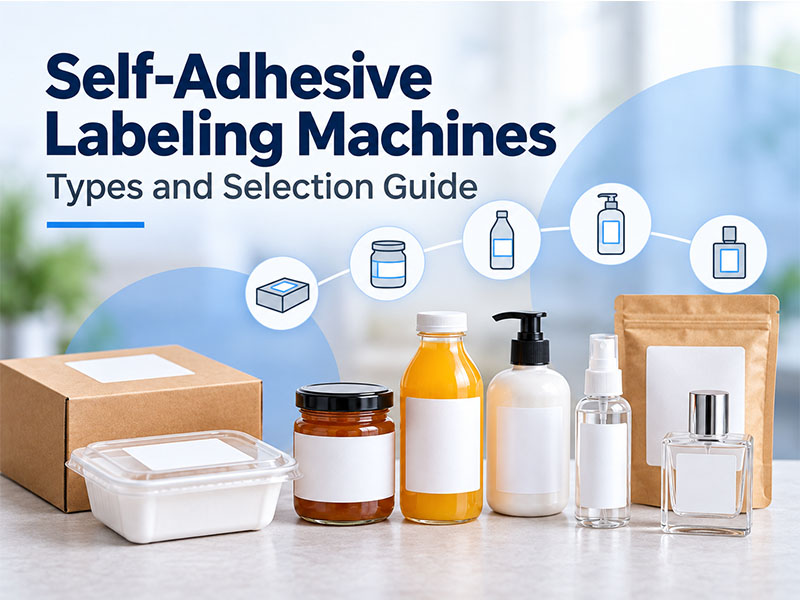
Self-adhesive labeling machines apply pressure-sensitive adhesive (PSA) labels directly to product surfaces, eliminating the need for additional glue. These systems are widely utilized across the food and beverage, cosmetics, pharmaceutical, and daily chemical industries.
EPK Machinery specializes in manufacturing both semi-automatic and fully automatic self-adhesive labeling machines to accommodate diverse product shapes, labeling positions, and production capacities. From flat surfaces to round bottles and complex multi-side applications, we help customers identify and customize the optimal equipment for their specific operational needs.
2. Types of Self-Adhesive Labeling Machines
Labeling machines are generally classified by automation level, product shape, and labeling position.
By Automation Level
-
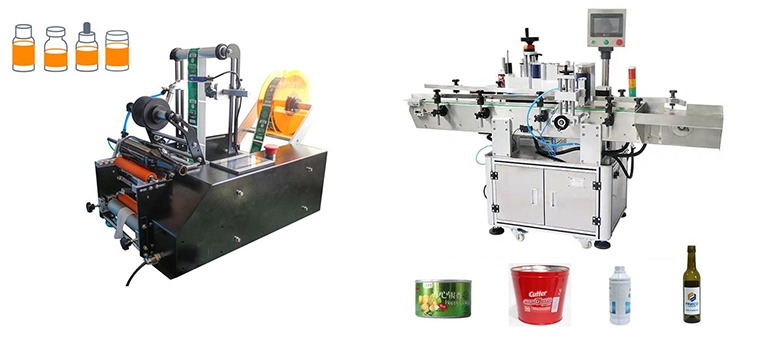
Semi-Automatic Labeling Machines: Ideal for small-batch production, flexible operations, and applications requiring manual product loading or positioning.
-
Fully Automatic Labeling Machines: Engineered for automated product feeding and high-speed labeling, seamlessly integrating into existing packaging lines.
By Product Shape and Labeling Position
-
Top Surface Labeling Machine: Applies labels precisely to the upper surfaces of flat products, boxes, cartons, and trays.
-
Top and Bottom Labeling Machine: Applies labels to both the upper and lower surfaces simultaneously for enhanced efficiency.
-
Round Bottle Labeling Machine: Designed for cylindrical containers, including bottles and jars. Optional positioning systems ensure highly precise label placement.
-
Double-Sided Labeling Machine: Applies labels to two opposite sides of bottles or containers (typically the front and back).
-
Three-Sided Labeling Machine: Applies labels to three surfaces of compatible containers based on their geometry and label layout.
-
Four-Sided Labeling Machine: Labels all four surfaces of square or rectangular containers for comprehensive branding.
The optimal configuration depends on product dimensions, surface characteristics, label specifications, and required production speed.
3. What Information Is Needed to Select the Right Labeling Machine?
To recommend the most suitable labeling machine for your application, please provide the following technical details:
3.1 Product Dimensions and Geometry
Please specify the product's dimensions (length, width, height, or diameter and height) and its basic shape (e.g., round, flat, square, or irregular).
3.2 Product Material
Is the product constructed from plastic, glass, metal, or paper? Please note its surface texture (hard, soft, or easily scratched).
3.3 Label Specifications and Quantity
What are the label dimensions? Does each product require a single label, dual labels, or multiple labels?
3.4 Labeling Position
Where should the label be applied? Please provide product photos indicating the required labeling positions.
3.5 Product Weight and Labeling Stage
What is the approximate product weight? Will labeling occur before or after the filling process?
3.6 Required Production Speed
What is your target output? Please specify the number of products to be labeled per minute or per hour.
3.7 Labeling Accuracy
Are there specific tolerance requirements for label positioning or alignment?
3.8 Machine Installation
Will the machine operate as a standalone unit or connect to an existing production line? If integrating, please provide the conveyor height.
3.9 Printing Requirements
Do you require integrated printing for dates, batch numbers, barcodes, or QR codes?
3.10 Special Requirements
Are there any environmental or special operational requirements, such as avoiding scratches, eliminating air bubbles, or operating in dusty/humid environments?
Please provide as much technical information as possible, along with product photos and label samples if available. This will enable us to recommend the labeling machine that best suits your production needs.